BFA Minors

Minors

Do you want to expand your skill set, gain an advantage in a niche field, or demonstrate your passion in a discipline you intend to incorporate into your art, career, or life?
Our minors supplement your major studies and help you discover ways to employ your creative practice in real-world settings. Our Academic & Community Engagement Minors include Art & Entrepreneurship, Art History, Public Engagement, Sustainable Ecosystems: Art & Design (SEAD), and Writing. Our Studio Minors include Drawing, Metalsmithing & Jewelry, Music, Printmaking, and Woodworking & Furniture Design.
Art & Entrepreneurship
The Art & Entrepreneurship Minor gives students the opportunity to pursue an entrepreneurial focus across studio disciplines. Through project-based, experiential courses, client projects, internships, workshops and community partnerships, students develop a range of skills to launch and successfully grow their entrepreneurial endeavors. This interdisciplinary minor is designed to help students transform any discipline or concept into a real-world venture.
Students are required to take The Art of Business (NS 250) and other Art and Entrepreneurship courses to complete the minor. The minor is 15 credits total.
Art History
Studying Art History at Maine College of Art & Design helps you understand the historical and social contexts of your work, develop writing and critical thinking skills, and create art individually and collaboratively.
By completing the required 15 credits of Art History courses, you'll gain knowledge in the history of world art--both Western and non-Western. Requirements include two semesters of Art History Survey, one non-western art history course, one elective art history course, and one semester of Critical Issues, a 200-level critical theory course. At the end of your degree, you'll have learned about art history from ancient to contemporary art.
Public Engagement
The Public Engagement minor is a four-year program that integrates art, real-world problems, and community partners into its teaching curriculum. This program is designed to support the College's dynamic curriculum, engage students more deeply, and prepare them with professional and interpersonal skills that set them apart in the workforce. Graduates seamlessly apply the skills they learned to create positive change as creative and social agents in the world. Our interdisciplinary curriculum has been part of our pedagogy for over 25 years. Together, we learn and apply the skills of co-creating, designing, building, and activating our world to make it better for all.
Sustainable Ecosystems: Art & Design (SEAD)
Sustainable Ecosystems: Art & Design (SEAD) takes a place-based approach to learning that transforms the Southern Maine landscape of coastal wetlands and tide-pools, urban forests and public parks into a laboratory for investigating climate change.
SEAD students will apply both their creative and analytical skills to investigate the most important issue of our time: sustaining life on Earth. This interdisciplinary curriculum brings ecological studies together with studio art practices; addressing real world problems, students will gain a knowledge base for “green” technology and planning, water conservation, natural resource management, environmental design and creative problem solving.
Writing
This 18-credit Writing Minor, which is comprised of a diverse range of creative and expository writing courses, allows students to further enrich their artistic journey while developing exceptional communication and deep reading skills. In the Writing Workshop, which is the capstone experience, students complete a peer-edited, personal writing project—novel, graphic novel, screenplay, poetry compilation, memoir, essay—with the goal of publication.
Sponsored through the Liliane Willens Endowed Academic Support Fund.
Drawing
With the advent of postmodernism, artistic practices have splintered into an ever-widening variety of possibilities that has redefined the role of drawing in the contemporary art world. Beginning with the New York School and subsequently considering Pop, Minimalism, Conceptualism, Process Art, Graffiti, Performance, and Installation, drawing has persevered as a necessary artistic practice and has, through the variety of difference inherent in postmodern aesthetics, developed into a vital, autonomous art form in itself.
Metalsmithing & Jewelry
A minor in Metalsmithing & Jewelry embraces a discipline of making which integrates an expansive range of materials and objects in relationship to bodies, the human hand, and conceptual inquiry. Through foundational skills in traditional metalsmithing techniques using non-ferrous metals, stone, plastics, and glass-onmetal, you will explore how small-scale objects operate as wearable adornment, functional objects, hardware, mechanisms, and art objects.
Music
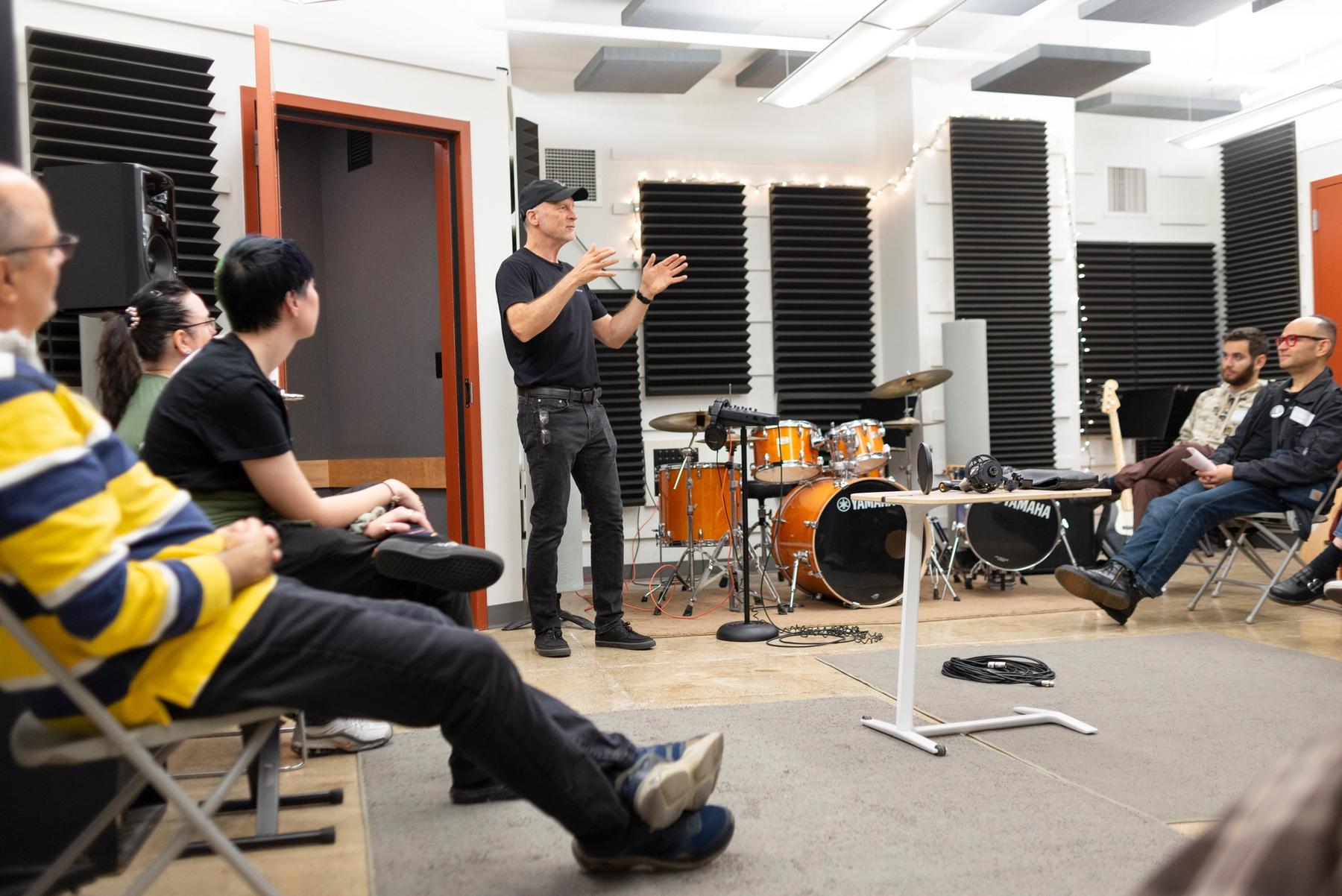
The Bob Crewe Program in Art and Music enables students to explore the deep relationship between art and music. Made possible by a $3 million bequest from the Bob Crewe Foundation, this program is unique in that it is fundamentally embedded into the Art and Design program, not separated from it.
The goals of the program are to foster experimentation in art and music, to support significant contributions to popular musical expression, and to do both in a way that encourages interdisciplinary exploration. The program, working in tandem with the College's rigorous visual arts offerings, prepares students to cross traditional boundaries as musicians, performers, sound artists, artists and thinkers.
Printmaking
The Printmaking minor introduces print as both a conceptual language and a set of tools and techniques. Classes approach printmaking as an exploration of borderlands—between uniqueness and multiplicity, found and fabricated imagery, and utilitarian documents and fine art objects. You will build foundational technical skills while experimenting with a range of materials, methods, and processes. Grounded in the language of print, the minor encourages you to develop your own ideas and expand your broader studio practice, while engaging the continued relevance of print media in contemporary art and culture.
Woodworking & Furniture Design
Rooted in New England’s rich craft tradition, the Woodworking & Furniture Design minor allows you to work with wood through both traditional and contemporary methods. In MECA&D’s well-equipped studios, you will gain hands-on experience with machinery, hand tools, and digital fabrication processes while exploring ideas of utility, ergonomics, and design. Through this coursework, you will connect making with meaning and develop confidence working in a shared studio environment.